What is a 1998 armagnac?
A vintage armagnac bears the name of a single harvest. A 1998 armagnac is therefore made solely from grapes harvested in the autumn of 1998, made into wine and then distilled the following winter, and never blended with other years. This is what sets it apart from a VSOP, an XO or a hors d'âge, whose label states a minimum age rather than a date. The vintage, on the other hand, tells the story of a precise harvest and of the work of one house.
The starting point is a dry white wine, designed for distillation, made from the grape varieties of the appellation: ugni blanc, baco, folle blanche and colombard. Ugni blanc brings finesse and fruit, baco roundness, folle blanche floral elegance. During the winter, this wine goes through the armagnac still, in continuous distillation, following the traditional method of Gascony.
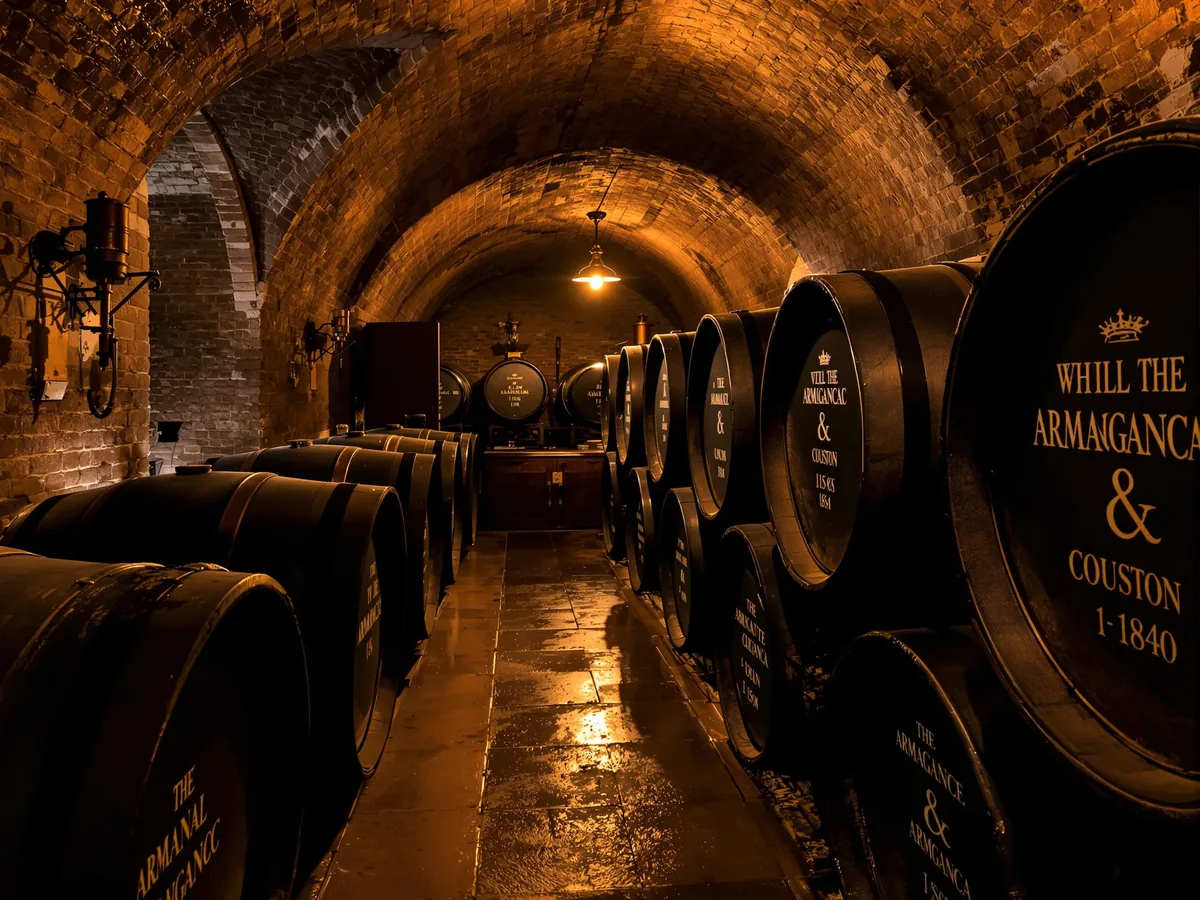
The brandy that comes out is colourless. It then goes into oak casks, in the cellar, for long ageing: there it takes on its colour, its tannins and its vanilla and spicy aromas, while part of the alcohol evaporates. Good to know: armagnac only ages in the cask. Once in the bottle, it no longer evolves. The bottling date, when shown, tells you how long your 1998 really spent in wood.
1998, the year of Les Bleus
In France, 1998 remains the year of the first football World Cup won by the French team, on home soil: on 12 July 1998, Les Bleus beat Brazil 3 to 0 in the final, and a huge crowd gathered that same evening on the Champs-Élysées (source: Wikipedia, article "Coupe du monde de football 1998"). During that festive summer, in the vineyards of the Gers, the harvest that gave the bottles on this page was ripening.
Our 1998 armagnacs, estate by estate
Nine Bas-Armagnac houses kept their 1998 brandies in cask before bottling them. The same harvest, but not the same soil, nor the same grape varieties, nor the same length of ageing:
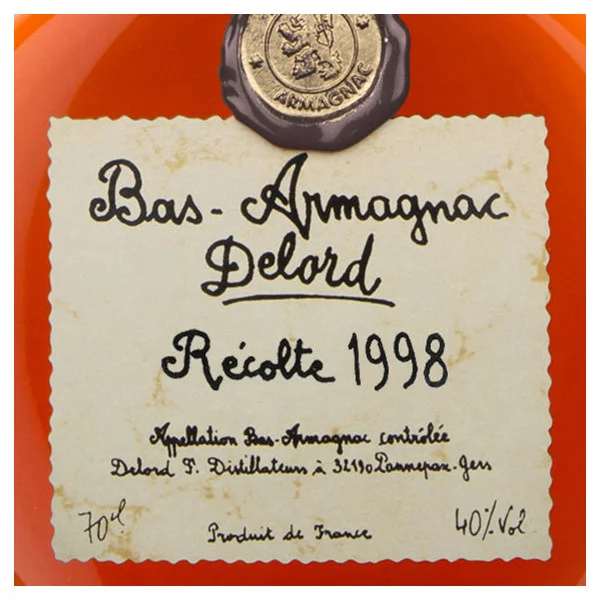
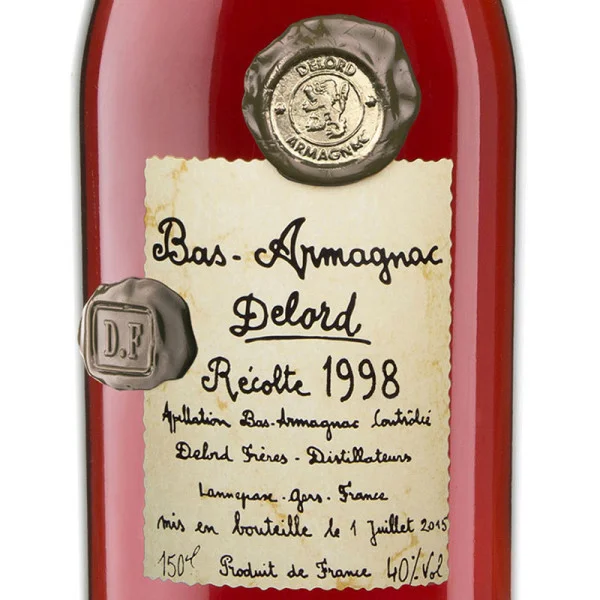
- Armagnac Delord, a family house in Lannepax founded in 1893: a 1998 at 40% ABV, in 70 cl and 150 cl magnum, with a caramelised, lightly oaky nose of clove, verbena, prune, date and a hint of fig; the palate is round and charming, "rustic in the best sense of the word" according to the house, and the finish long, spicy and lightly smoky;
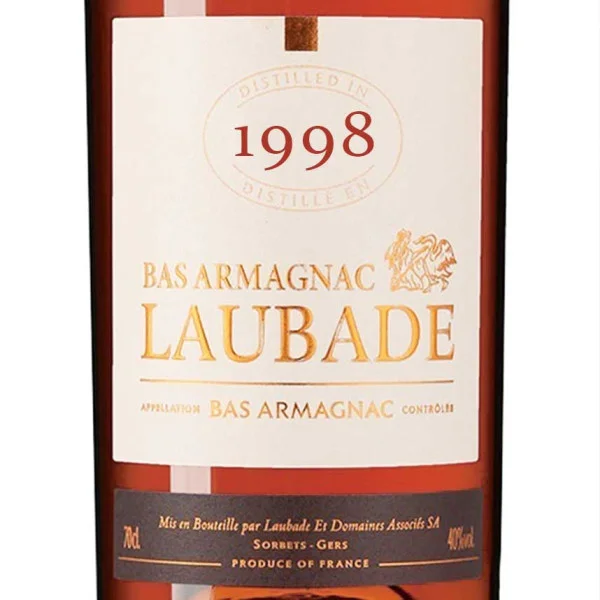
- Château de Laubade, in Sorbets: a 1998 at 40% ABV, made from the four grape varieties baco, ugni blanc, folle blanche and colombard, aged in 420 litre Gascon oak casks, with plum and candied fruit wrapped in oak, and a supple, round palate with toasted and vanilla notes;
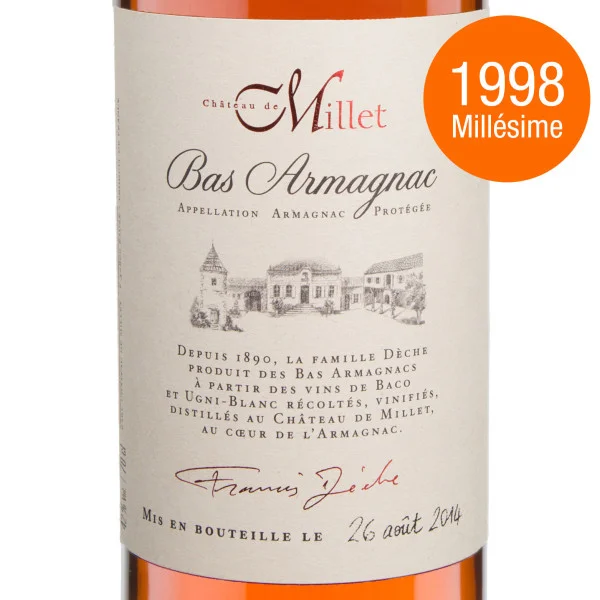
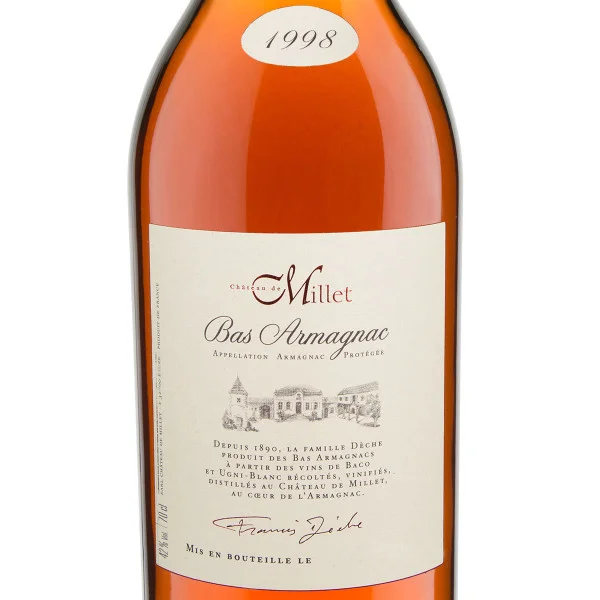
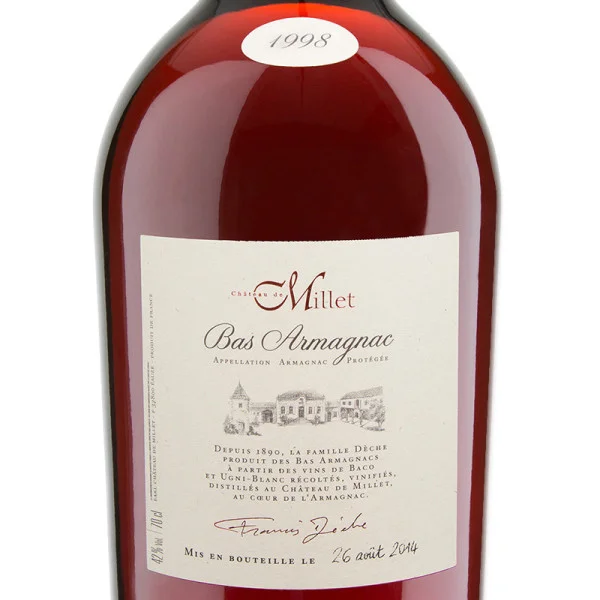
- Château de Millet, the Dèche family estate in Eauze: a 1998 at 42% ABV, from baco and ugni blanc, gold medal at the Concours Général Agricole de Paris 2019, in 70 cl, magnum and 250 cl Gascon pot;
- Dartigalongue, in Nogaro since 1838: a 1998 at 42% ABV, with a nose of spices and candied fruit giving way to roasted notes, very indulgent and round on the palate, with quince and frangipane, and a spicy finish;
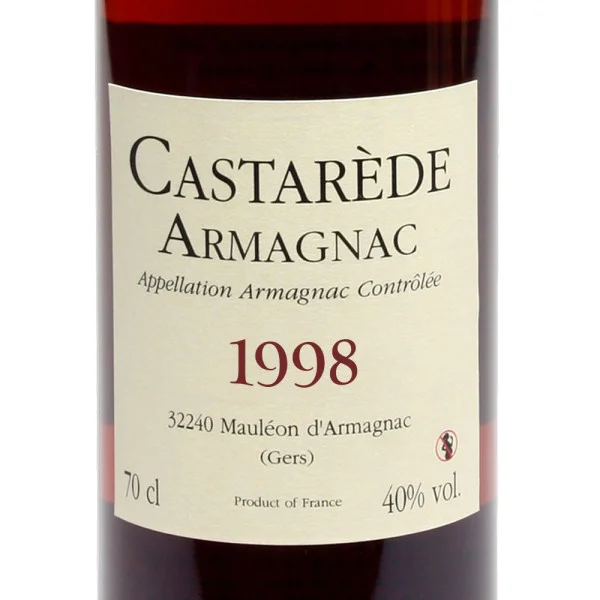
- Armagnac Castarède, a house founded in 1832: a 1998 at 40% ABV, which spent 22 years in cask before being bottled in 2020;
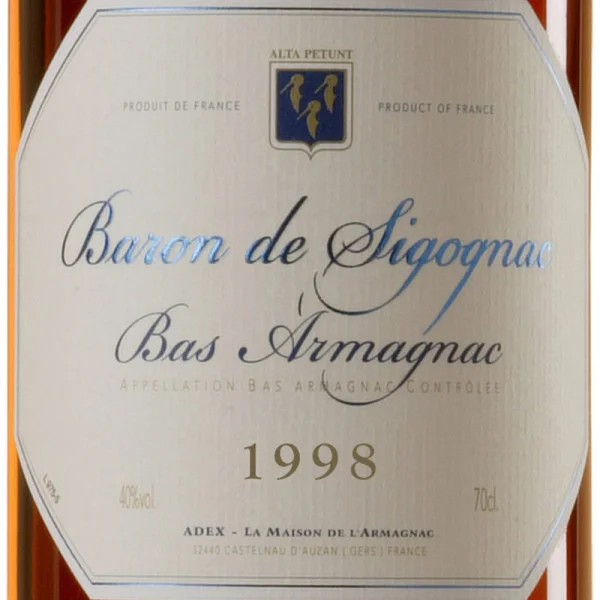
- Baron de Sigognac: a 1998 at 40% ABV, from ugni blanc and baco, aged at Château de Bordeneuve;
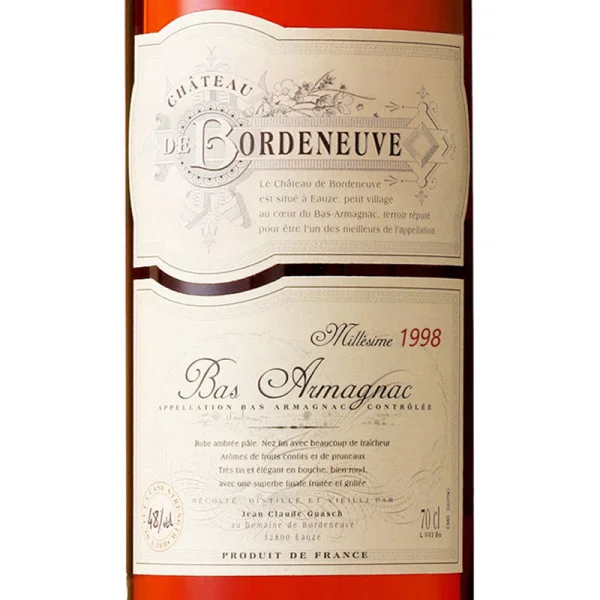
- Château de Bordeneuve, in Castelnau d'Auzan: a brut de fût (cask strength, not reduced) at 48% ABV, pale yellow with golden highlights, with a fine, elegant nose of fresh fig, prune d'ente plum and vanilla;
- Clés des Ducs: a 1998 at 40% ABV, distilled in Panjas, never blended, with deliberately light oak to preserve the fruit;
- Jean Cavé, in Lannepax since 1883: a brut de fût at 49.7% ABV, bottled without reduction.
These last two brut de fût bottlings, at over 45% ABV, join our other brut de fût armagnacs.
The terroir of Bas-Armagnac and its tawny sands
The armagnac appellation, in the South West, stretches across the Gers and spills over into the Landes and Lot-et-Garonne. It has three terroirs: Bas-Armagnac, Ténarèze and Haut-Armagnac. All our 1998 bottles come from Bas-Armagnac, whose tawny sand soils produce fine, fruity brandies. At Château de Millet, for example, the vines grow on these tawny sands, over eighty hectares north-west of Eauze; Château de Laubade farms a hundred hectares in a single block around Sorbets. On this same soil, each estate then leaves its mark through its grape varieties, its still and the way it manages ageing.
Characteristics and aromas of 1998 armagnac
At 28, an armagnac keeps its freshness. Its colour ranges from pale yellow with golden highlights, for a brut de fût such as Bordeneuve, to the mahogany gold described by Millet. The notes published by the houses draw an indulgent profile: candied fruit, plum, prune, fig, date, quince, vanilla, caramel, frangipane, spices and touches of toast or roasting. The palate is often round and supple, with integrated tannins and fine length.
The strength changes the perception a great deal. A 1998 at 40 or 42% ABV is soft and approachable; a brut de fût around 48 or 50% ABV is more intense and rewards a patient approach. To taste it, serve it at room temperature in a tulip glass, let it breathe for a few minutes, warm the glass in your hand, then taste in small sips.
How to choose your 1998 vintage armagnac
For a first discovery, a reduced vintage is the simplest choice: Château de Millet in fact recommends its 1998 to introduce a newcomer to the pleasure of armagnac. For a connoisseur who likes power, choose a brut de fût. Awards are also a useful guide, such as Millet's gold medal in 2019. Finally, think about the size: the Delord or Millet magnum and the Millet Gascon pot mark a large gathering.
Giving a 1998 armagnac for a 28th birthday or a 28th wedding anniversary
In 2026, people born in 1998 celebrate their 28th birthday, and couples married in 1998 their 28th wedding anniversary. An armagnac from their year is a gift that bears the exact date, to open on the day of the celebration or to keep for the 30th. Depending on the house, the bottle comes in a case or a gift box.
To keep it, store the bottle upright, away from light and heat. Unopened, it keeps for a very long time; once opened, it keeps for several months.
Frequently asked questions about 1998 armagnac
How much does a 1998 armagnac cost?
It depends on the estate, the size (70 cl, magnum, Gascon pot), the strength and the type of bottling, reduced or brut de fût. Each product page on this page shows the producer, the bottle size and the price.
Which estates produce 1998 armagnac?
In our selection: Delord, Château de Laubade, Château de Millet, Dartigalongue, Castarède, Baron de Sigognac, Château de Bordeneuve, Clés des Ducs and Jean Cavé, all in Bas-Armagnac.
What are the aromas of the 1998 armagnac?
Depending on the house: candied fruit, plum, fig, quince, vanilla, caramel, spices, toast. Each product page includes the tasting notes published by the estate.
Where can I buy a 1998 armagnac online?
At Plaisirs de Gascogne, an online wine and spirits merchant specialising in vintage armagnac: the bottles come directly from the Gascon houses, payment is secure and delivery is handled with care, in France and across Europe.
Also discover all our vintage armagnacs, year by year, or the 1996 armagnac for a neighbouring vintage.
Please enjoy responsibly. Excessive alcohol consumption is harmful to health.



 Jean Cavé
95 bottles
Jean Cavé
95 bottles
 Armagnac Delord
92 bottles
Armagnac Delord
92 bottles
 Château de Millet
79 bottles
Château de Millet
79 bottles
 Dartigalongue
75 bottles
Dartigalongue
75 bottles
 Baron de Sigognac
69 bottles
Baron de Sigognac
69 bottles
 Armagnac Castarède
59 bottles
Armagnac Castarède
59 bottles
 Clés des Ducs
48 bottles
Clés des Ducs
48 bottles
 Château de Laubade
31 bottles
Château de Laubade
31 bottles
 Château de Bordeneuve
17 bottles
Château de Bordeneuve
17 bottles
 Domaine de Pellehaut
17 bottles
Domaine de Pellehaut
17 bottles
 Charles de Granville
13 bottles
Charles de Granville
13 bottles
 Roger Groult
7 bottles
Roger Groult
7 bottles